
Fraud Detection
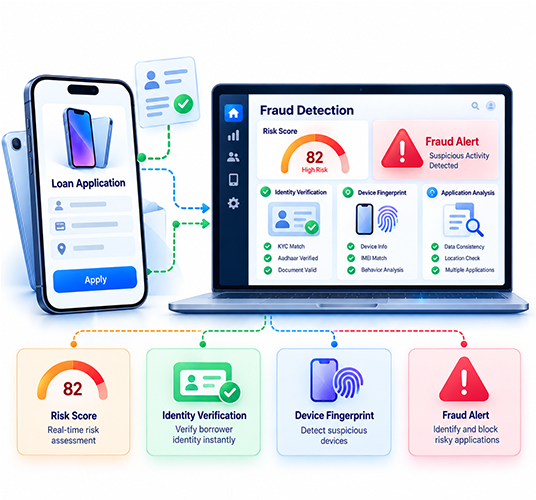
Device financing fraud rarely announces itself. The documents look right. The application clears a basic check. A straw buyer walks in and presents exactly like a real customer. The problem only surfaces weeks or months later — when a pattern in the data becomes impossible to ignore. By that point the devices are gone and the losses are already on the books.
Why Fraud Is Hard to Catch Early
Risk Signals From the Start — Not After the Fact
How Fraud Detection Runs
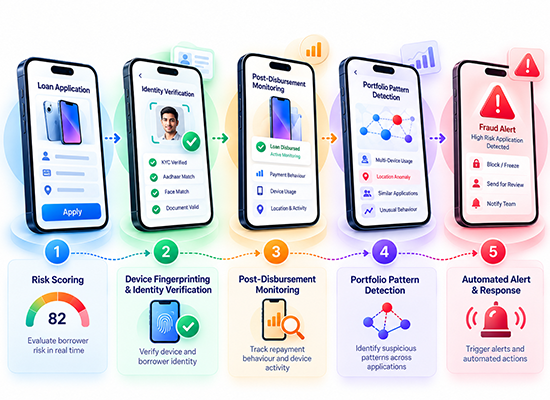
Risk Scoring at Origination
Risk signals evaluate every application before a lending decision is made — identity verification, device fingerprinting, and behavioural patterns generate a score underwriting teams can act on.
Device Fingerprinting & Identity Verification
Identity signals, device fingerprinting, and application behaviour are assessed in the background of the origination flow — no added latency, no disruption to the application process.
Post-Disbursement Monitoring
After disbursement, device behaviour is monitored for anomalies — unusual usage patterns, bypass attempts, signals suggesting the device may have changed hands. Any of these can trigger an alert.
Portfolio-Level Pattern Detection
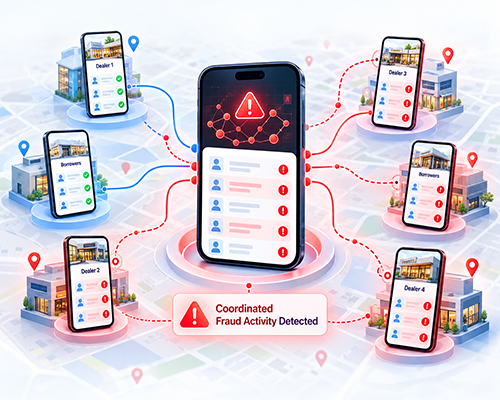
Cross-account patterns are watched continuously. A fraud ring hitting twenty dealer locations simultaneously doesn't get far before the portfolio-level view flags it — even if each individual location only sees one or two unusual applications.
Automated Alert & Response
When a threshold is crossed, alerts fire. Where configured, the response is automatic — device restriction, account flag, escalation to the risk team. How much is automated vs. human-reviewed depends on how you've set it up.
Core Capabilities Of The Platform
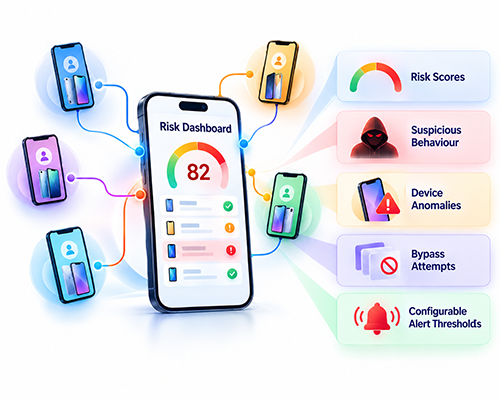
Risk scoring at point of application
Device fingerprinting & identity verification
Post-disbursement behavioural anomaly detection
Portfolio-level pattern monitoring
Configurable alert thresholds & escalation flows
Reset protection & bypass attempt detection
WHY CHOOSE US
What Earlier Detection Actually Means
- Fraud caught at origination costs one rejected application — not a device, a loan balance, and collection effort
- Portfolio-level pattern detection catches coordinated activity no individual underwriter could see
- The shift from after-the-fact discovery to front-end prevention isn't incremental — it's the difference between a near-zero loss and a fully booked one
- Device-level signals often tell you more than a document check ever could — especially in markets with less mature identity infrastructure
- Automated screening scales with volume — manual review doesn't, and fraud that slips through tends to repeat before anyone catches it
— USE CASES —
Built For Real Business Challenges
High-Volume Lending Portfolios :
The more applications you process, the more critical automated screening becomes — manual review doesn't scale, and the fraud that slips through a manual process tends to repeat before anyone catches it.
Multi-Dealer Networks
Portfolio-level monitoring is the only view where coordinated fraud becomes visible. A fraud ring hitting twenty dealer locations simultaneously doesn't get far before it's flagged — even if each individual location only sees one or two unusual applications.
Emerging Markets
Less mature identity infrastructure means device-level signals often tell you more than a document check ever could — enforcement that doesn't depend on the quality of the document being presented.
BNPL & Micro-Lending
Faster origination cycles create more opportunity for fraud. Risk scoring at application is what keeps the economics from falling apart — catching problems before the device leaves, not after.
— INDUSTRIES
Who We Serve
Telecom Operators :
Risk scoring and device fingerprinting embedded across postpaid handset EMI and prepaid bundles — fraud signals active from the first application, not discovered after the device has left.
NBFCs & Lenders :
Portfolio-level monitoring across dealer networks — the only vantage point where coordinated fraud becomes visible before it's already run through thousands of accounts.
Fintech Companies :
Fraud detection built into your BNPL or embedded finance origination flow — configurable alert thresholds and escalation rules that fit your risk profile, not a generic ruleset.
Retailers & Distributors :
Device fingerprinting and behavioural signals at the point of sale — catching straw buyers and coordinated fraud before the application is approved and the device walks out.
Frequently Asked Questions
Common questions about fraud detection for device financing.
Stop Fraud Before It Costs You
Risk signals built into origination — not discovered after the device has left.