
Launch Device Financing Without Building the Risk Layer Yourself
The opportunity in device financing for fintechs is real. Smartphones are the most wanted consumer purchase in emerging markets, demand for installment options is strong, and fintechs have the customer relationships and distribution to offer them well. What most fintechs don't have is the six months and engineering budget to build the risk infrastructure from scratch. Loksiz provides that infrastructure via API — device control, risk management, automated collections — plugged in from day one.
How do fintechs get into device financing quickly?
The fast path is integrating a DFRM platform via API or SDK, rather than building enforcement, collections, and monitoring from the ground up. Plug into infrastructure that already handles the risk side from day one — instead of spending months on something that's never going to be your actual product.
What Usually Slows This Down
Launching device financing products requires strong risk management, enforcement capabilities, and scalable operational infrastructure.
Slow, expensive infrastructure
Building secure risk infrastructure for device financing isn't a weekend project — it requires OEM relationships, enforcement at the device level, and the compliance scaffolding to hold it together.
Default risk at scale
Managing default risk without the right tools compounds faster than most expect — what seems manageable at a few thousand accounts becomes a serious problem at a hundred thousand.
Inconsistent repayment
Teams that try to build risk infrastructure in-house often spend six months on it and launch a version that can't handle defaults at any real volume.
Fragmented systems
Stitching together multiple tools to cover the lifecycle creates hand-offs and gaps that grow alongside the portfolio.
What Changes With
the Right Infrastructure
Faster to market, less risk, a financing model that actually scales with the business.
Faster time to market
API-first, integrates in days — launch without a long development cycle, instead of spending six months on infrastructure that was never going to be the actual product.
A financing model that scales
Infrastructure that handles rapid growth from the start — no rebuild needed at 10x volume.
Less risk exposure
Device locking and enforcement included out of the box — not an upsell, not a separate build.
Better borrower experience
Consistent automated operations mean a better experience for the borrower — not three confused messages from three disconnected systems.
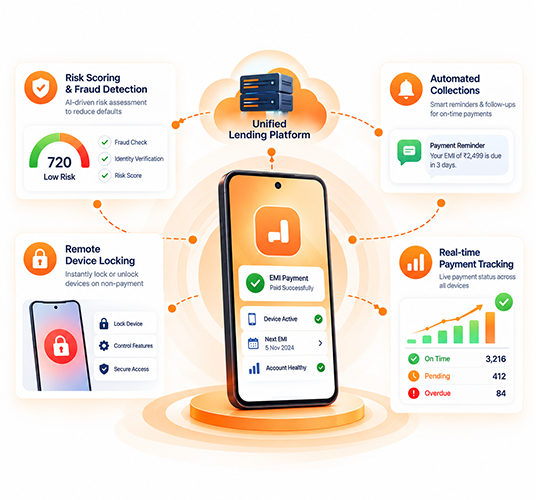
Infrastructure Built for Fintech Scale
Four things that work together so you don't have to build any of them — plugged in from day one, so the product can launch without half a year of work on the risk layer.
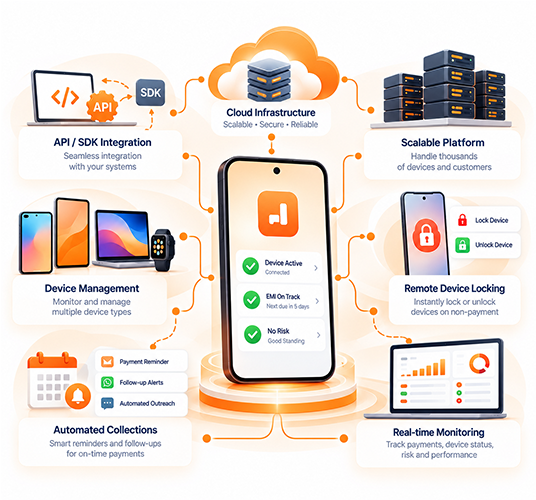
API & SDK Integration
Integrate device financing capabilities into existing products in days, not months — API and SDK live from day one.
Built-In Device Enforcement
Device locking and enforcement included out of the box — not an upsell, not a separate build.
Automated Collections
Fully automated collection workflows — no manual steps, no person triggering each stage of a process that should run itself.
Scalable Infrastructure
Infrastructure ready for rapid growth — no rebuild needed at 10x volume, capacity planning is proactive if growth significantly exceeds projections.
Where It Fits
If a device leaves your hands before it's fully paid for, this is built for that situation — across fintech lending models and product types.
Embedded Device Financing
Smartphone financing offered directly inside the fintech app — risk controls and device enforcement included, no separate infrastructure build.
Learn MoreApp-Based Lending Products
Device-backed lending with automated collateral protection — enforcement that actually acts when payments stop, not just a credit score penalty.
Learn MoreBNPL Smartphone Financing
Buy-now-pay-later financing with built-in risk management — scale the product without scaling the default rate alongside it.
Learn MoreLaunch Device Financing Faster
API-first, integrates in days — device control, risk management, and automated collections ready to go, so you can focus on the product, not the infrastructure.