
Lower NPAs
Without Adding Friction
for NBFCs & Lenders
Device lending has a risk characteristic that general lending tools weren't built to handle. Once the handset is disbursed, the lender's collateral is in the borrower's pocket — easy to keep using regardless of payment status. Loksiz provides what's missing: real-time payment tracking, risk scoring at origination, remote device locking for accounts in default, and collection workflows that run without manual triggering. Four things working together as one system.
How do lenders actually reduce this risk?
Track repayment behaviour live. Use risk scoring to flag borrowers showing early warning signs. Enforce payment through device locking when communication alone isn't cutting it. A DFRM platform ties all three together in one system — instead of three tools that don't talk to each other.
Where the Risk Concentrates
Lenders face growing pressure to reduce defaults while maintaining portfolio growth.
Here's where it actually shows up.
Higher risk borrower segments
Smartphone lending often reaches borrower segments with thin credit histories — making origination screening more important, not less.
Limited recovery once in default
Once a loan defaults, recovery options are limited — collections calls are easy to ignore, field visits are expensive, and without device-level leverage the path back is slow and uncertain.
Collections teams stretched thin
At high volumes, manual case-by-case follow-up can't keep pace — collections teams triggering every step of a process that should be running itself fall behind before anyone notices.
Fraud at the point of application
Fraudulent applications are hard to catch without the right signals — and by the time they surface the device has already left.
What Actually Moves
the Bottom Line
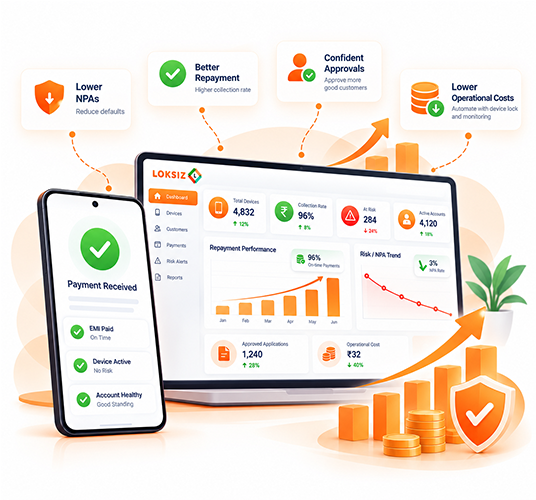
Reduced NPAs, better repayment discipline, lower operational cost — measurable impact across portfolio performance.
Reduced NPAs and portfolio losses
NPAs fall when repayment discipline has real teeth — a borrower with an immediate consequence for non-payment behaves differently from one who knows the only response is a call they can decline.
Better repayment discipline
Enforced repayment and proactive risk scoring reduce defaults before they compound into portfolio losses — across all borrower segments.
More confidence in approvals
Risk scoring at origination gives underwriters something concrete to decide on — particularly for applications in the grey area that could go either way.
Lower operational cost per loan
Automation handles the routine so the team focuses on cases that actually need judgement — lower operational cost per loan managed without cutting corners on the cases that matter.
Built for Lending-Scale Device Financing
Four things working as one system — not four separate tools the team has to bridge manually.
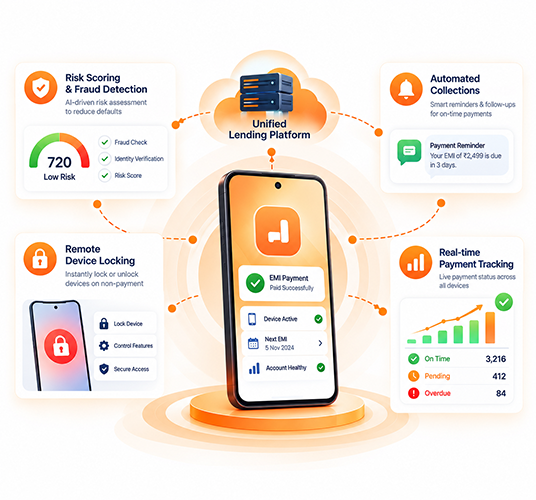
Risk scoring and fraud detection
Risk scoring and fraud detection from the point of onboarding — before the loan is approved, not after.
Automated collection workflows
Automated collection workflows that don't need someone to manually trigger each step.
Remote device locking
Remote device locking for accounts in default — with automatic unlock on payment confirmation.
Real-time payment tracking
Real-time tracking across the whole loan portfolio — not a batch file from last night.
Where It Fits
If a device leaves your hands before it's fully paid for, this is built for that situation — across lending models and ticket sizes.
EMI-Based Smartphone Financing
EMI-based smartphone financing with risk management and device control from day one — every device enrolled, every payment tracked, every default escalated automatically.
BNPL Device Loan Programs
BNPL device loan programmes with automated payment monitoring and lifecycle management from enrollment to closure.
Micro-Financing & Last-Mile Lending
Micro-financing and last-mile lending with the risk controls needed to keep exposure manageable even at small ticket sizes — where the economics depend on keeping defaults very low.
Strengthen Your Lending Operations
Lower NPAs, better repayment discipline, lower cost per loan managed — without adding headcount to make it happen.