
Scale Financing
Without Scaling Risk
for Telecom Operators
Smartphone financing has become a standard part of how telecoms compete for subscribers. Postpaid plans, subsidy programmes, installment-based handset sales — all reasonable growth levers until default rates start climbing and the economics shift quietly underneath you. Loksiz provides the risk controls to match: payment monitoring, remote device locking, automated collection workflows — built into the operation from the start.
How do telecom operators actually manage device financing risk?
In practice it comes down to three things working together: payment monitoring, enforcement through device locking, and automated collection workflows. A DFRM platform brings all three under one roof — full visibility and control, without building internal infrastructure from scratch.
Where the Pressure Shows Up
Operators face mounting risks when extending device financing to subscribers at scale.
Here's where it actually hurts.
Elevated default rates
Default rates across contract and subsidy programmes compound quietly — by the time they show up in the quarterly numbers, the losses have been building for a while.
Almost no leverage
Once a device is in a subscriber's hands, there's almost no practical leverage to enforce repayment — calls and messages are easy to ignore, and there's no faster option.
Manual-heavy collections
Collections teams working case by case can't keep pace with volume — manual processes fall behind before anyone notices.
Fraud at scale
Coordinated fraud rings spread applications across multiple dealer locations so no single branch sees enough to raise an alarm — repeating across thousands of accounts before anyone sees the full picture.
What Actually Moves
the Bottom Line
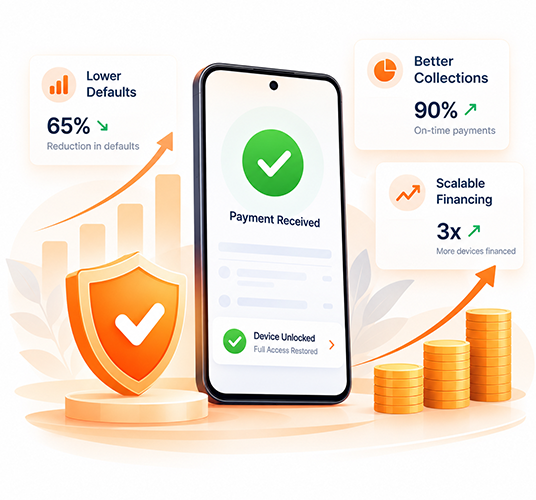
Lower defaults, better collections, higher financing uptake — measurable impact across financial and operational metrics.
Lower default rates
Enforced repayment and proactive risk scoring reduce defaults before they compound rather than after — churn-related losses fall as a direct result.
Better collection efficiency
Improved collection efficiency without scaling headcount — automation covers what manual follow-up can't at volume.
Higher uptake of financing products
Greater customer uptake once the programme actually works and subscribers can see it's a serious offering.
Secure device distribution at scale
Device distribution that's accountable at scale — not just in a controlled pilot, including in lower-connectivity markets.
Built for Telecom-Scale Financing
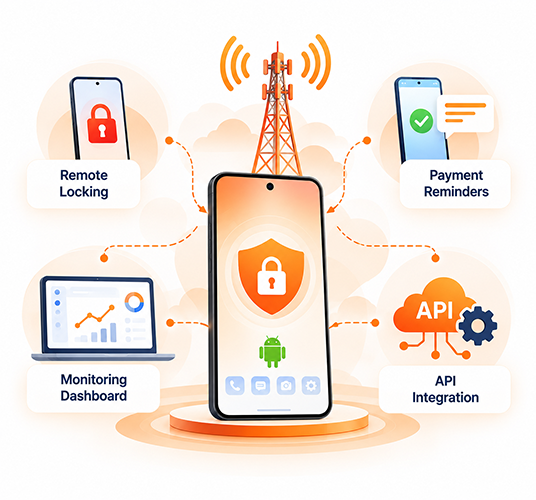
Everything needed to run a financed device portfolio at scale — from first payment to final closure, in one platform, without replacing existing infrastructure.
Remote device locking
Remote device locking tied to payment status in real time — not on a delay.
Automated reminders
Automated reminders and escalation workflows that run without manual triggers.
Centralised monitoring
Centralised monitoring across the entire device estate — one dashboard, every device.
API integration
API integration with the billing and CRM systems already in place — no ripping out what works.
Where It Fits
From postpaid smartphone plans to subsidy-backed device programmes — if a device leaves your hands before it's fully paid for, this is built for that situation.
Postpaid Device Financing
Postpaid device financing plans with automated risk management and device control built in from day one — not added after problems appear.
Learn MoreContract-Based Plans
Contract-based smartphone programmes with payment monitoring and lifecycle management from enrollment through to closure.
Learn MoreSubsidised Handset Distribution
Subsidised handset distribution with the risk controls needed to keep financial exposure manageable at scale, including in lower-connectivity markets.
Learn MoreScale Device Financing with Confidence
Risk controls built in from the start — grow your financing portfolio without growing your default rate alongside it.