
The Enforcement Lever You've Been Missing
Lock a financed smartphone remotely the moment a payment's missed. Restore it the moment the balance clears. No field visit, nobody driving out to grab the phone — just a direct line between payment status and whether the device works.
A direct lever over financed devices, basically. Borrower misses a payment, you restrict access remotely. They catch up, you reinstate it instantly. That's the whole difference between chasing someone for money and having accountability already built into the product.
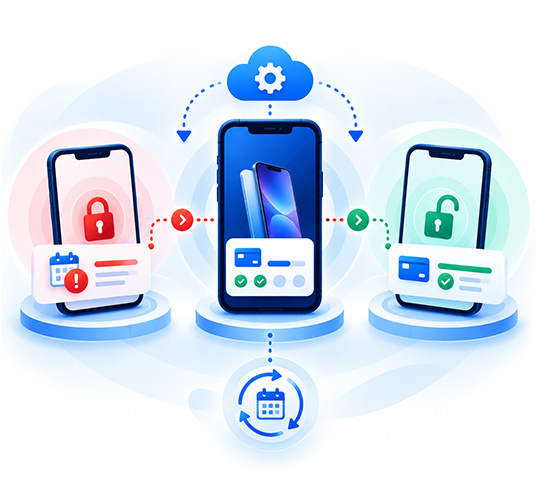
Without It, Default Is the Easy Choice
No mechanism to enforce repayment, and a struggling borrower has very little reason to stay current. Collections is left with calls and messages — no real leverage behind any of it.
Why Chase-Only Collections Fail On Mobile EMIs
The device keeps working long after payments stop. Collections is left with calls and messages, no real leverage behind any of it. Recovery costs climb while success rates sit flat.
By the time a field agent is dispatched, the asset is gone and the recovery cost exceeds any plausible return.
Direct, Reliable Control — Wherever the Device Is
Automatic locking the moment a payment's missed. Instant restoration once the balance clears. Policy-based rules tied to your own repayment schedules. Control through API or through the Android SDK — whichever fits how your team already works.
How the Lock-Unlock
Cycle Works
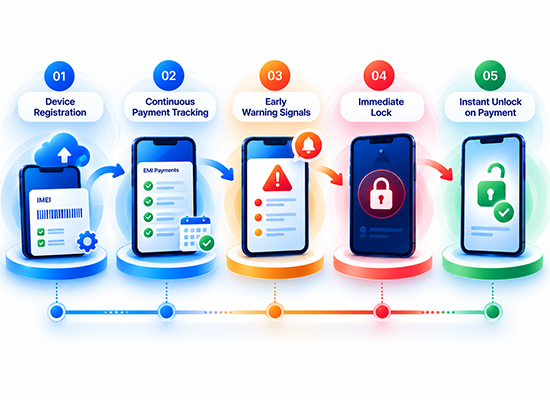
Device Enrollment
Onboarded at the point of financing via API or SDK. Register the device with loan metadata — IMEI, model, loan ID, tenure, and first due date.
Policy Configuration
Define exactly when and how locking triggers — your rules, not ours. Grace days, DPD bands, and escalation stages configured per your policy.
Payment Monitoring
Status tracked in real time against the schedule you've configured — rules engine decisions based on current facts, not last night's batch file.
Lock on Default
Miss the threshold, access gets restricted remotely. Immediately, not eventually. Graduated restrictions rather than a blanket brick — notices before restriction, emergency calling protected.
Unlock on Payment
Settle the balance, access comes back right away — typically within seconds of payment confirmation. No ops team member required.
— Key Features
Two Ways to Lock a Device
DLC (Device Lock Controller)
App and SDK-based locking embedded right into the device. Lightweight, deploys widely, works across Android — no OEM commercial agreements required on day one.
Native OEM Locking
Deeper, hardware-level integration with device manufacturers — built for high-volume or high-risk programs where you want something more robust than software-only enforcement.
Enterprise API Integration
Server-to-server REST with webhooks for full automation — lock triggers, unlock on payment, no manual approval step required at any stage.
Retailer App Deployment
Use the Android agent app for lock/unlock at the shop floor without an immediate API build — with a clear path to full automation later.
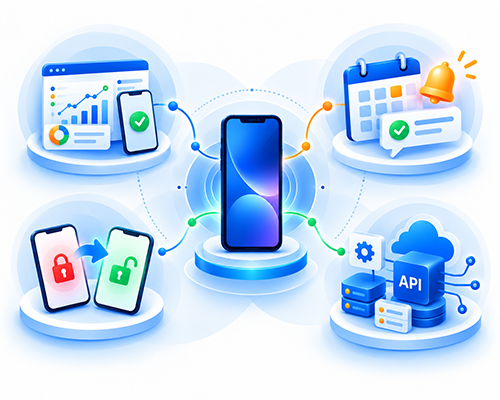
Business Impact
↓
Real reduction in
loan defaults
↑
Repayment discipline
across the portfolio
↓ Cost
Per collection vs
field visit baseline
↑ Rate
Higher recovery
rates portfolio-wide
Seconds
Unlock fires after
payment confirms
— USE CASES —
Built For Real Business Challenges
Reduce Loan Defaults :
Lock on default, release on recovery. A struggling borrower — or one who's just decided not to bother — now has a concrete reason to stay current. Not a guilt trip. A consequence.
Improve Collection Efficiency :
Lower cost per collection. Higher recovery rates. A financing operation that's just sturdier, structurally, than one running without any enforcement layer at all.
Combine Locking With Fraud Controls :
Real-time enforcement — actually real-time, not real-time-with-a-lag. Configurable locking policies. Offline lock execution, for when a device drops off the network and the command just waits.
Pay-On-Lock-Screen UX :
Branded lock screen with the exact amount due and a one-tap payment option. Borrower is motivated — their daily-use phone is restricted — and payment is one tap away.
The smart solution for mobile device financing businesses.
From NBFCs to retail chains — protect every financed device in your portfolio. Both DLC and native OEM locking models are supported. Which one makes sense depends on your operation, honestly.
Book DemoTelecom Operators :
Scale postpaid handset EMI programmes and prepaid affordability bundles with built-in graduated device enforcement.
NBFCs & Lenders :
Financing handsets through dealer networks — faster deployment without OEM commercial agreements required on day one.
Fintech Companies :
Embed smartphone BNPL with a compliant device control layer — API-first with full audit logs and policy templates built in.
Retailers & Distributors :
Use the Android agent app for lock/unlock at the shop floor without an immediate API build — with a clear path to full automation later.
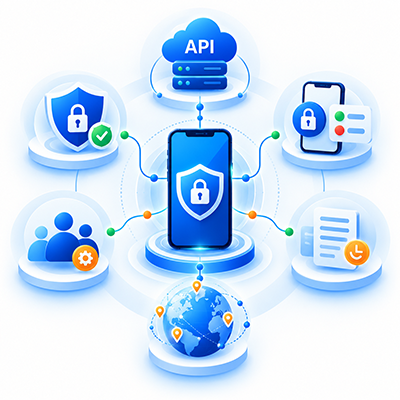
SECURITY, WITHOUT THE FINE PRINT
Built to Plug In. Built to Hold Up.
REST API, fully documented. Android SDK for device-level control. Plays fine with existing lending and CRM systems. Built to scale globally — not redesigned later when you expand into a second market.
- End-to-end encrypted device communication
- Authenticated, tamper-resistant lock commands
- Role-based access across your team
- Full audit logs — so when compliance asks, you actually have something to show them
- Scales globally — not redesigned later when you expand into a second market
Frequently Asked Questions
Common questions from lenders, retailers, and fintechs evaluating device locking.
Take Control of Financed Devices, in Real Time
Enforce repayment. Protect your portfolio. Keep operations lean.